
Everyone knows the Sagrada Família. Almost no one knows Gaudí.
Yesterday marks exactly one hundred years since Antoni Gaudí died alone in a hospital for the poor.
Nobody recognized him. Three taxis refused to pick him up off the street. They mistook him for a vagrant.
He was on his way to pray.
The man who designed the most photographed building in Spain died that way. Unidentified, in a charity ward, on an ordinary afternoon in Barcelona. Today, Pope Leo XIV celebrates mass at the Sagrada Família on the exact centenary of his death. It seemed like a good day to remember the man, not just the building.
The young architect who took the job for money
Gaudí did not begin the Sagrada Família out of faith. He was 31 years old when he took over the project in 1883, after the previous architect resigned. It was a professional opportunity like any other. He wanted to satisfy the client, build a reputation, advance his career. His closest collaborators left written accounts describing a man very different from who he would later become.
The radical faith came later. And when it arrived, it changed everything.
In the last twelve years of his life, Gaudí abandoned every other project. He moved into a small workshop inside the Sagrada Família itself. He lived there. He adopted vows of poverty. He stopped charging fees. His clothes were so plain that people on the street mistook him for a beggar.
That detail, which seems minor, is what determined how he died.
The day nobody knew who he was
On June 7, 1926, Gaudí left the Sagrada Família in the late afternoon. He told one of his collaborators: "Vicent, come early tomorrow, we'll do beautiful things." He was heading to the oratory of San Felipe Neri, where he went to confession every day.
At six in the evening, a tram hit him on the Gran Via.
Nobody recognized him. Three taxis refused to take him, assuming he was a drunk or a homeless man. A civil guard finally forced a vehicle to carry him to the Hospital de la Santa Creu, Barcelona's hospital for the poor.
He died three days later, on June 10, 1926. One hundred years ago today.
When Barcelona learned who had died in the charity ward, thousands of people filled the streets to say goodbye. He was laid out in the habit of the Franciscan Third Order, a wooden cross between his hands. His remains rest in the crypt of the Sagrada Família, the building he gave his life to.
Why his architecture looks like nothing else
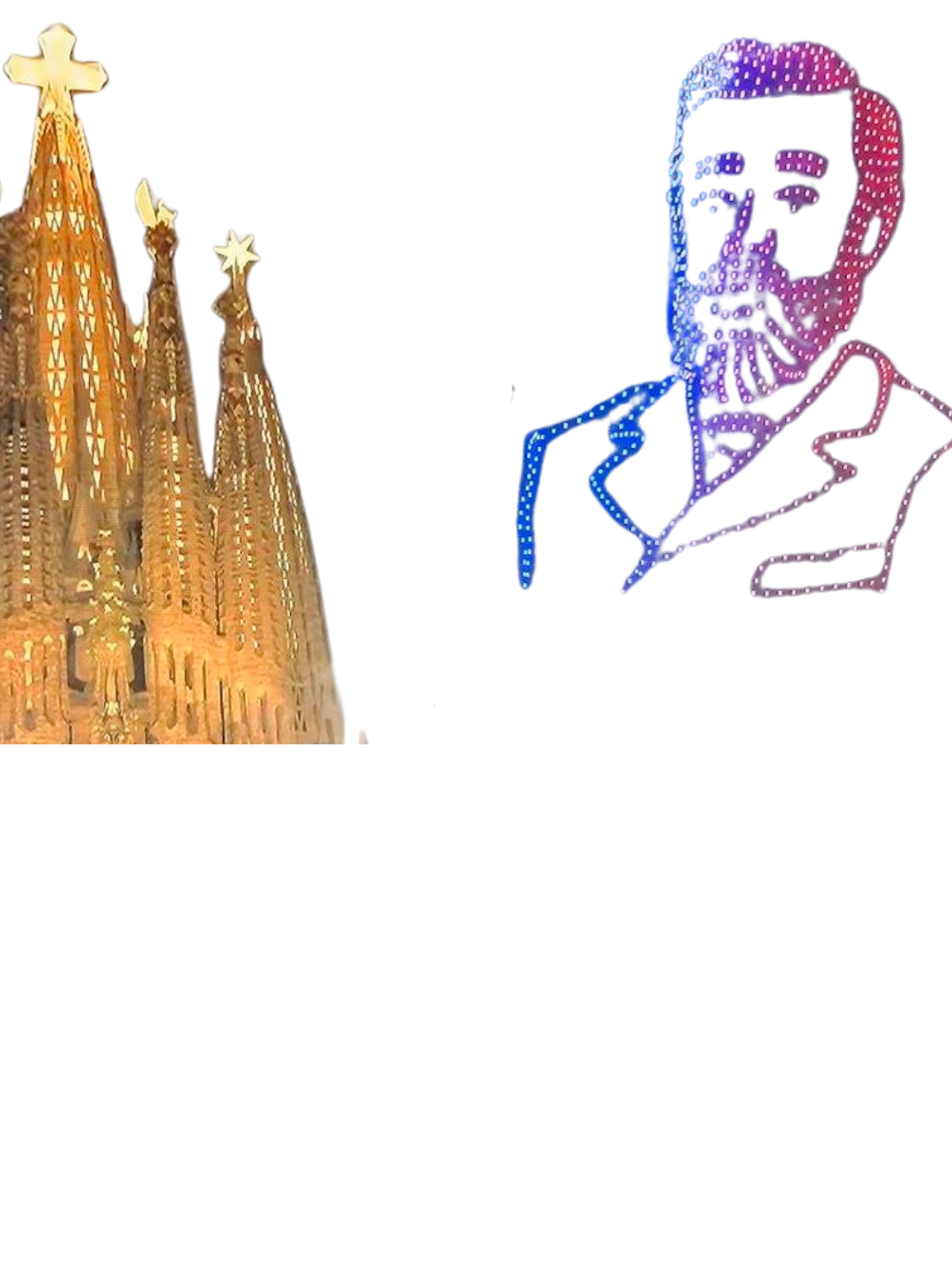
There is a question I keep coming back to when I look at photos of the Sagrada Família next to any other Gothic cathedral in Europe. Why is it so different?
The cathedrals of Chartres, Cologne, Notre-Dame share a visual logic: height, verticality, light filtered through stained glass, flying buttresses holding up walls that would otherwise collapse. They are beautiful and monumental. But they follow the same grammar.
The Sagrada Família does not.
Gaudí rejected straight lines because he said they did not exist in nature. His columns branch like trees. His vaults imitate the canopy of a forest. He designed hyperboloid paraboloids for the domes decades before mathematicians popularized them in modern architecture. And when people asked him when the building would be finished, he answered: "My client is not in a hurry."
His client was God.
One detail strikes me as the most revealing of all. Gaudí designed the tallest tower of the Sagrada Família, the one Pope Leo XIV blesses today at 172.5 meters, intentionally shorter than the mountain of Montjuïc. Because he believed no human work should surpass nature, which was God's work.
That decision says everything about how he thought.
What stays with me
I am a believer. And there is something in Gaudí's story that unsettles me in a way I cannot quite explain.
A man who began a work knowing he would never see it finished. Who grew poorer as the project grew larger. Who died alone in a charity hospital, mistaken for a vagrant, on his way to pray. And whose work today receives the Pope one hundred years later, with the tallest tower in the world dedicated to Christ.
There is a coherence in that life that is hard to dismiss. Not the coherence of success, but of someone who found something worth believing in and followed it to the end, without calculating the cost.
Yes, as the Pope blesses that tower in Barcelona, it seems worth remembering not just the building but the man who dreamed it. The one who started for money and ended dying for faith, unrecognized on a street in Barcelona.